
Has the economy entered an era of low growth?
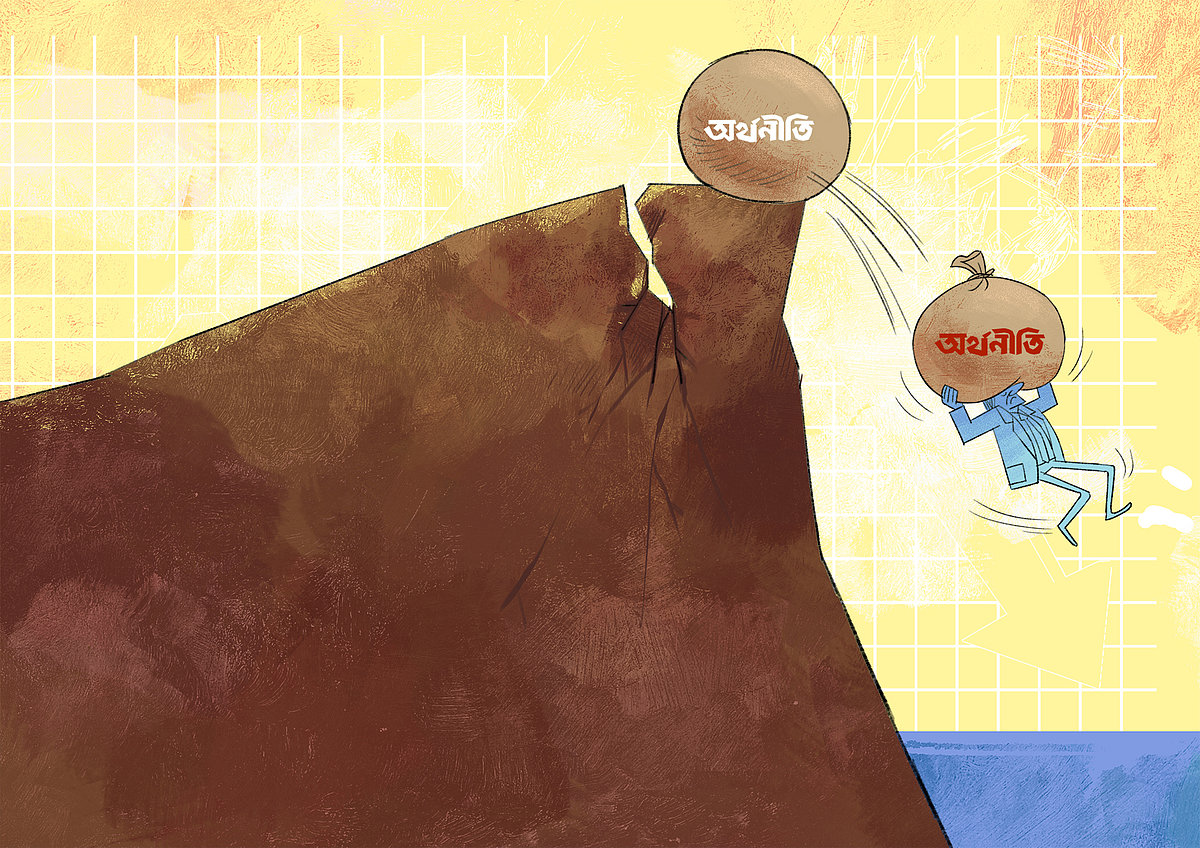
Once time is gone, efforts cannot succeed. This government has completed nine months but has not shown a good start in the economy. If the issues of political balance had been resolved initially, today's Bangladesh would have been in a different state. Trying to emulate Yunus's strategies, it has fallen into a low growth trap. Since they did not decision properly, political and governance instability is now increasing. This has been reflected in the minds of the IMF and the World Bank. The IMF's growth forecast for Bangladesh over the next five years can be summed up in one phrase, "This spring full of sorrow, seems like it never came before." No one from the IMF or World Bank has previously shown a five-year era of low growth consecutively for Bangladesh.
According to the IMF's projection, Bangladesh’s average growth from 2027 to 2031 will be 2.82 per cent, which is not only the lowest in the region but also a sure sign of entering an era of low growth. A high-growth country, often referred to by researchers as an emerging economy, is now out of that list! Bangladesh itself is not wanting to get out of the "Least Developed Country" status for another three years, thereby reaffirming the certificate of low growth. Why did Bangladesh fall from "acceleration" of growth to "deceleration"? It is now crucial to find answers as to why this transition from acceleration to economic slowdown happened. Did Bangladesh really experience growth acceleration? The average growth in the 1980s was 3.5 per cent, which increased to 4.7 per cent in the 1990s, 5.6 per cent in the 2000s, and 6.6 per cent in the 2010s.
The COVID year should be considered exceptional, when saving lives was the priority. In that year, India's, Pakistan's, Nepal's, Bhutan's, and Sri Lanka's growth turned negative, while Bangladesh managed to achieve a growth rate of around 3.5 per cent. Post-pandemic, the acceleration of growth persisted until 2023, with an average growth rate of 6.6 per cent from 2021 to 2023. Analysing the growth trend reveals this upward trajectory was evident and statistically significant. This trend was broken from 2024 onwards, marking the start of an era of low growth. Growth fell to 4.2 per cent. The interim Yunus government further lowered this to 3.5 per cent.
Although the BNP government expects the growth for the current fiscal year to rise to 6.5 per cent, the World Economic Outlook report suggests it might be 3.6 per cent. Bangladesh is not only caught in low growth, but this trend line is also consistently downward-facing, which hasn't been seen since 1981. According to the IMF's observation, in the 2027-2031 five-year period, Bangladesh's average growth will be the lowest in the region. During this period, Sri Lanka is projected to have an average growth of 3.5 per cent, Pakistan 4.3%, Nepal 4.9 per cent, Bhutan 6.4 per cent, and India 6.9 per cent. How did a regional "development miracle" suddenly become the "weakest performer"? Vietnam, a country often compared to Bangladesh, is expected to have an average growth over 6 per cent in the same period.Kaushik Basu, former Chief Economist of the World Bank, once wrote in the New York Times about "Booming Bangladesh".

মতামত দিন