
RMG factory owners have 'no money,' workers can’t afford food, what’s the solution?
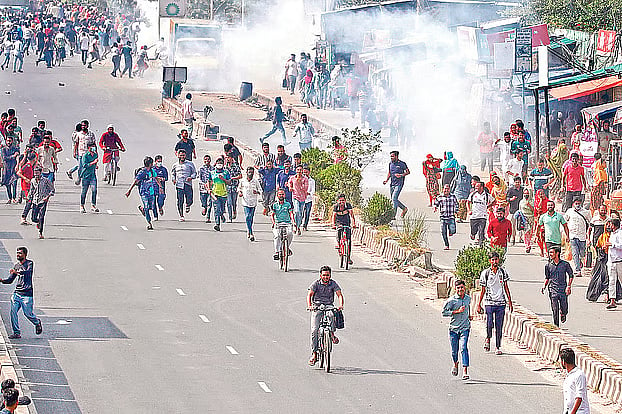
Nasima Akhter, a sewing machine operator in Nishchintapur, Ashulia, earns Tk 14,500 at the end of each month. She has a family of six to support.Her second son was supposed to sit for his SSC examinations this year. But the family could not afford the examination registration fees, so he could not sit for the exams. During the same week, the managing director of a garment industry group said that, under the current circumstances, “not a single factory owner has the capacity to increase wages by even one taka.”Factory owners say they have no money; workers say they cannot make ends meet. The problem is that both are telling the truth.And sitting comfortably between these two truths, with a quiet smile, is someone who is neither on the streets nor at the wage board—and does not even live in this country: the foreign buyer.After workers blocked roads from Mirpur to Gazipur demanding a monthly wage of Tk 30,000, the Minimum Wage Board was formed on 1 November.At its second meeting on 9 November, the workers' representatives submitted a written demand for Tk 32,000—a 156 per cent increase over their current wages.Workers also took to the streets in 2023 demanding higher wages. Four workers were killed, and more than 70 factories were vandalised.At the time, the Wage Board increased the minimum wage by 56 per cent, raising it to Tk 12,500. But the workers had demanded Tk 23,000.Let's assume the board raises wages by 50 to 70 percent this time. Monthly wages would then stand at Tk 18,750 to Tk 21,250—still Tk 11,000 to Tk 13,000 below the workers' demand. That gap is where the fuel for the next explosion is accumulating.Inequality has added fuel to the workers' anger. Under the new pay scale, the basic salaries of government employees are set to nearly double, while private-sector employees do not even receive a 10 per cent annual increase So let's make this clear from the outset: this is not a bargaining dispute between factory owners and workers; it is an illness of the economy. And police batons or wage board meetings are no cure for an ailing economy. If you cut off someone's head to cure a headache, the pain may indeed disappear—but so does the person.Taking inflation into account, brands now buy T-shirts at nearly half the price they paid 25 years ago. Yet workers' wages account for only 12 percent of that priceWhy is the danger greater this time? This time, four pressures have converged simultaneously.First, inflation. Poor economic management, printing money to finance government borrowing, and the Iran war have all contributed to soaring prices.Diesel prices alone have risen from Tk 100 to Tk 135 per litre this year. According to the IMF's forecast, average inflation in the current fiscal year will be around 11 percent. The wages set in 2023 cannot sustain workers in the 2026 marketplace.Second, a weakening economy. According to provisional Bangladesh Bureau of Statistics (BBS) figures, private investment as a share of GDP stood at just 21.53 percent in the last fiscal year—the lowest level in 14 years.The IMF forecasts economic growth of only 3.2 percent, lower than during the COVID-19 pandemic.Third, pressure on the informal sector. Pavement shops and easy-bikes (battery-powered three-wheelers) served as an unofficial safety net for people who had lost their jobs. Evictions are tearing that safety net apart, and angry street vendors are now joining workers' marches.Fourth, politics.
Ousted Prime Minister Sheikh Hasina has announced that she will return in December. And there is no shortage of people looking to fish in troubled waters.But these are merely sparks. The real stockpile of gunpowder has been accumulating inside the industry itself.A joint press briefing by the two associations representing garment manufacturers—the Bangladesh Garment Manufacturers and Exporters Association (BGMEA) and the Bangladesh Knitwear Manufacturers and Exporters Association (BKMEA)—at the BGMEA office in Uttara. BGMEA President Mahmud Hasan Khan is speakingSelling cheap, yet finding no buyers Trump's tariffs on China could have been a lottery ticket for us. In February, we even overtook China to become the second-largest exporter to the US market.But in August, despite carrying the burden of steep tariffs, China overtook us again.According to OTEXA data, Bangladesh's exports to the United States fell by 4.57 per cent between January and September, amounting to $6.14 billion.Cambodia's exports increased by more than 6 percent, while Vietnam managed to retain its market share despite raising prices. The setback in Europe has been even greater. China, having faced difficulties in the US market, has made an aggressive push into Europe.Between January and August, Bangladesh recorded the highest rate of export decline to Europe among all countries. The extent of that decline was discussed in this very newspaper last week in an article titled Three Houses on the Same Street.During the same period, China's exports to Europe actually increased by 2.38 percent. Prices are also falling. Our garments fetch €13.76 per kilogram in Europe, compared with €19.82 for Chinese products.While our competitors are raising their prices, we cannot maintain export volumes even by selling more cheaply. Exports to the US have declined by 3.65 per cent.It is like a shopkeeper at a marketplace who offers the lowest price of all but still cannot find customers.Even loss-making factories cannot afford to close More than 2,000 factories are competing for a shrinking pool of orders. Many manufacturers have concluded that taking orders at a loss is better than leaving their machines idle. On that calculation, some are accepting orders at prices below their production costs.Who pockets the profit? Research by Public Eye and the Clean Clothes Campaign shows that Bangladesh accounts for 61 percent of the cotton T-shirts imported into Europe.In 2025, the average price of these T-shirts in Europe was $2.67, while Bangladeshi T-shirts fetched just $2.06.Taking inflation into account, brands now buy T-shirts at nearly half the price they paid 25 years ago. Yet workers' wages account for only 12 percent of that price.According to our straightforward calculations, even doubling workers' wages would increase the production cost by only about 25 cents per T-shirt. The same T-shirt sells in retail stores for between $12 and $20.In a healthy market, loss-making factories shut down. Here, however, closing a factory is the most expensive option.Take Beximco, for example. Following the closure of 14 factories, outstanding dues to 33,244 workers amounted to Tk 525 crore—more than Tk 150,000 per worker. Ultimately, the government had to settle those payments.Even an ordinary factory employing 10,000 workers faces legal liabilities exceeding Tk 75 crore when it closes. On top of that, there are rescheduled loans: the moment a factory shuts down, it risks being classified as a loan defaulter.That is why factories continue operating despite mounting losses, until they finally run out of steam.According to Industrial Police data, 457 industrial establishments have permanently closed over the past two years, including 170 textile and garment factories.The garment sector alone has seen approximately 150,000 workers lose their jobs.Dollars disappearing from workers' pockets In December 2023, a monthly wage of Tk 12,500 was worth $113.
Today, it is worth just $101. The figure in taka remains the same, yet $12 has disappeared from workers' pockets in just three years.Lucky, an operator in Gazipur, earns Tk 21,900 a month, including overtime, but still has to borrow money every month to make ends meet.Why are even machine operators joining the protests? Because the minimum wage is the first step on the wage ladder; when that step moves, every other step moves with it.Workers stage a protest by blocking the Dhaka–Tangail Highway in Gazipur, demanding an annual wage increase and other benefits. The demonstration took place beneath the flyover in the Naojor area of the cityOne factory owner has even included landlords on his list of those allegedly instigating the protests.The reason? Whenever wages go up, rents go up the very next day. Don't laugh—the statement is not entirely untrue.According to H&M, Bangladesh's seven competing countries, including China and Vietnam, all have higher minimum wages than ours.Cambodia's minimum wage this year is $210—more than double ours—yet the country is still managing to raise its prices in the European market. Cheap labour is no longer our trump card.Inequality has added fuel to the workers' anger. Under the new pay scale, the basic salaries of government employees are set to nearly double, while private-sector employees do not even receive a 10 per cent annual increase.Then, in May, another Tk 600 billion in incentives was announced, with the government covering 6 percent of the interest. There have been instances of such benefits being misused in the past as well.CPD proposes Tk 18,578–Tk 24,204 wage range for garment workersSeven proposals for the government The cure for an ailing economy must come from within the economy itself. The government does not have the financial capacity to subsidize the industry indefinitely. So there are two possible ways forward: increase income and reduce costs.1. Gradually adjust the value of the takaFactory owners are telling us that if the dollar rises from its current rate of Tk 124 to Tk 130 or Tk 135, they will be able to pay a minimum monthly wage of Tk 25,000.Consider a factory that exports $1 million worth of goods every month. If half of its earnings go towards raw materials, the remaining $500,000, converted at Tk 135 per dollar, would generate approximately Tk 5.3 million in additional monthly revenue.However, this would also increase foreign loan repayment costs and inflation. Therefore, any adjustment should be gradual and controlled. Currency depreciation can help, but it cannot be the sole source of funding higher wages.2. Break down the artificial barriers in the yarn marketThree restrictions have created a protected market for a handful of influential spinning mills:· A ban on yarn imports through land ports.· Requiring bank guarantees instead of bonded warehouse facilities for yarn in the 10-to-30-count range.· A directive requiring manufacturers to purchase half of their yarn from domestic mills.The price of 30-count yarn has already increased by around 15 cents per kilogram.For a knitwear factory requiring 100 tonnes of yarn a month, this translates into an additional monthly cost of approximately Tk 1.85 million—equivalent to the current wages of 150 workers.Tear down these barriers, but strengthen monitoring to prevent bonded yarn from being diverted into the open market.The real problems facing spinning mills are gas shortages and high interest rates. The remedies should target those problems directly.3. Prioritise energy supply to industrial zonesFuel and electricity should be prioritized for industrial areas. Due to shortages of gas and electricity, many factories are forced to run on diesel.According to a simple calculation by an engineer, if a generator produces 3.5 units of electricity per litre of diesel, the fuel cost alone comes to approximately Tk 38 per unit. By comparison, grid electricity for industrial consumers costs around Tk 14 per unit.Reducing this cost could translate directly into higher wages for workers.4.
Resolve the banking sector's bottlenecksIn September, private-sector credit growth stood at just 4.17 percent, the lowest in three decades.A special mechanism for loan restructuring should be introduced through the sale or merger of businesses. Factories should be allowed to pass into financially stronger hands while jobs are preserved.5. Stop extortion on the streets and bribery behind desksFactory owners have to pay money in two places: on the streets and across office desks.Last week's article included a basic calculation of these two forms of extortion. The situation in the garment sector is even more striking.Extortion on the streets does not disappear when the government changes; only the beneficiaries change. One factory in Tongi was forced to sell Tk 5 million worth of monthly garment waste (jhut) at half its market price. In effect, the extortionists pocketed an amount equivalent to the wages of 200 workers.At a meeting of the National Board of Revenue (NBR), the president of the Terry Towel Exporters Association went so far as to say: “Stop bribery, and we will never ask for tax reductions again.”Interestingly, this is one issue on which both sides agree.On 3 November, an organisation representing workers also stated that eliminating bribery at ports and extortion in transportation would reduce factory owners' costs substantially, making wage increases easier to implement.This does not require a budget. It requires political will.Workers from the garment sector stage protests by blocking roads in Mirpur's Sections 13 and 146. Annual wage adjustments, with buyers sharing the costWages should be adjusted every year, and buyers should also share the cost.Based on the average inflation rate over the past three years, if wages had been adjusted annually by 9.5 percent, the minimum wage of Tk 12,500 would have automatically risen to approximately Tk 16,400 by now.Under the amended Labour Act, wage reviews are currently conducted every three years. Cambodia, by contrast, reviews wages annually.The irony is that in 2023, 15 American brands wrote to the Prime Minister recommending annual wage reviews, alongside a commitment to “responsible purchasing practices.”Yet garment prices are moving in the opposite direction—they are falling.With that letter in hand, the government and BGMEA should secure a commitment from buyers to incorporate the cost of new wages into their purchasing prices.7. Avoid confrontation at all costsIn 2023, blanket cases were filed against 11,000 workers. That did not put out the fire.This time, in just five cases filed in Mirpur, approximately 11,500 unidentified individuals have been named as accused.Those responsible for sabotage should be arrested. But branding the entire movement as an Awami League agenda will only alienate genuinely angry workers.Nasima is not an agent of any political party. She simply could not afford the money needed to register her son for his examinations.In the long run: Fewer factories, stronger factories Does Bangladesh really need more than 2,000 garment factories?Through mergers, a smaller number of larger factories could gain greater bargaining power, spread fixed costs across higher production volumes, invest in technology and move into higher-value products made from synthetic fibres.Synthetic fibres now account for half of global garment trade. According to PwC, they make up just 27 per cent of Bangladesh's exports, compared with 56 per cent for Vietnam and 62 per cent for China.To achieve this, we need a clear exit policy that allows factory owners to leave the business at a lower cost after settling workers' dues.Thousands of our factories survive not because they are efficient, but because they cannot afford to shut down.In economic terms, these are called “zombie firms”: businesses that refuse to die even when they are effectively dead, while also dragging down the competitiveness of healthier factories around them.Making room for efficient businesses by allowing such firms to exit is known as “creative destruction”—a concept explained by Nobel laureates Philippe Aghion, Peter Howitt and Joel Mokyr, who received the Nobel Prize in Economics last year.However, if the cost of this destruction is placed entirely on workers' shoulders, it will no longer be creative.An effective exit policy must also include unemployment benefits and retraining programmes for displaced workers.No painless way forward Every option comes at a cost—higher inflation, political pressure, and the loss of some jobs.But the biggest mistake would be to treat an economic illness as a law-and-order problem and simply wait for the next explosion.If we stop after deciding on a new minimum wage figure, we will find ourselves back at the same barricades three years from now, with an even weaker industry.The garment industry accounts for more than 80 per cent of Bangladesh's exports and keeps the kitchens of millions of families running. What it needs is not blame, but sound calculations.And the calculation is not complicated. The government must stop extortion on the streets and bribery across office desks, factory owners must become more efficient, and buyers must pay that additional 25 cents per T-shirt.Otherwise, the foreign buyers' knowing smiles will not disappear. Only our factories will.* Fahim Mashroor is the founder of BDjobs.com.* Subail Bin Alam is an engineer-economist and a columnist on sustainable development. Email: contact@subail.com* This article has been translated into English by Ayesha Kabir


মতামত দিন